
Finding People Across Cedar City
Begin with the fact you can verify. A full name can lead to an Iron County owner account, a recorded deed entry, a Utah court party result, or a historic newspaper mention. An address works best in the county account search because it separates the physical site from the owner's mailing address. For an old name, a death date, or a family link, turn to cemetery files, probate indexes, vital records, and the Cedar City newspaper collection. Phone-only searches are less well served by official sources, so pair the number with a name or address before moving into public files.
Cedar City records do not sit in one office. City Hall holds municipal minutes, ordinances, contracts, licenses, cemetery records, and city requests. Iron County land and marriage records are centered in Parowan. Court, assessor, and public-health counters also operate in Cedar City, while statewide sites cover court cases, corrections, licenses, voter services, and vital certificates. A short, ordered search keeps those systems from blurring together.
- Search the Iron County EagleWeb account index by owner, parcel, or a structured Cedar City street address.
- Carry the owner or parcel into Document Search to find deeds, liens, plats, probate-related instruments, and other recorded entries.
- Check Utah Xchange for a party name, using spelling variants and a narrow court or date range when possible.
- For a deceased person or family line, compare vital indexes, cemetery series, probate records, and historical newspapers.
- When no portal holds the needed file, ask the correct custodian for a specific existing record.
Do not treat one match as proof. Owners may live away from the parcel, court names are entered as filed, and older newspapers can distort names through optical character recognition. Match two or more details such as a middle initial, parcel, spouse, year, or case role.
Cedar City Records Across Two Cities
Cedar City is not the Iron County seat. The city recorder works at Cedar City Hall, but the Recorder/Surveyor and County Clerk counters are about 20 miles north in Parowan. The Recorder handles deeds, mortgages, liens, plats, ownership maps, and cemetery filings. The Clerk handles elections, marriage licenses, county business licenses, passports, and County Commission records. The Clerk is explicitly not the clerk of courts. Cedar City court files instead route to the Fifth District Court or Iron County Justice Court.
The Iron County Assessor has a Cedar City office and maintains owner, parcel, value, and property-class information. Use that office to understand an account, not to obtain a deed image. For municipal records, the Cedar City Recorder is the city records manager and accepts GRAMA requests. Detailed classification, fee, and request rules belong with Cedar City public records access.
Published county hours are Monday through Thursday from 8 a.m. to 5 p.m. and Friday from 8 a.m. to noon. City Hall lists weekday hours from 8 a.m. to 5 p.m. Confirm current counter service before a trip.
Cedar City Owner and Parcel Search
Iron County EagleWeb provides a free Account Search for an owner, parcel, or Cedar City address. Owner results can include the mailing address, physical or situs address, parcel and account numbers, legal description, value, taxes, acreage, subdivision or public-land survey fields, district, and property class. Situs means the place where the parcel sits. A mailing address is where the tax notice goes. The two may differ, and neither proves who now lives at the site.
Search a street in parts: house number, compass prefix, street name, street type, suffix, and unit. That structure fits the Cedar City grid, where north and south numbering runs from Center Street and east and west numbering runs from Main Street. Named and curved roads may not follow the grid. If the address uses “Cedar City” for mail, confirm the Municipality Name and tax district because a postal city label does not settle the municipal boundary.
The Iron County GIS source shows the map context behind an account. The captured county parcel view illustrates how parcel geometry helps separate a mailing label from the land itself.
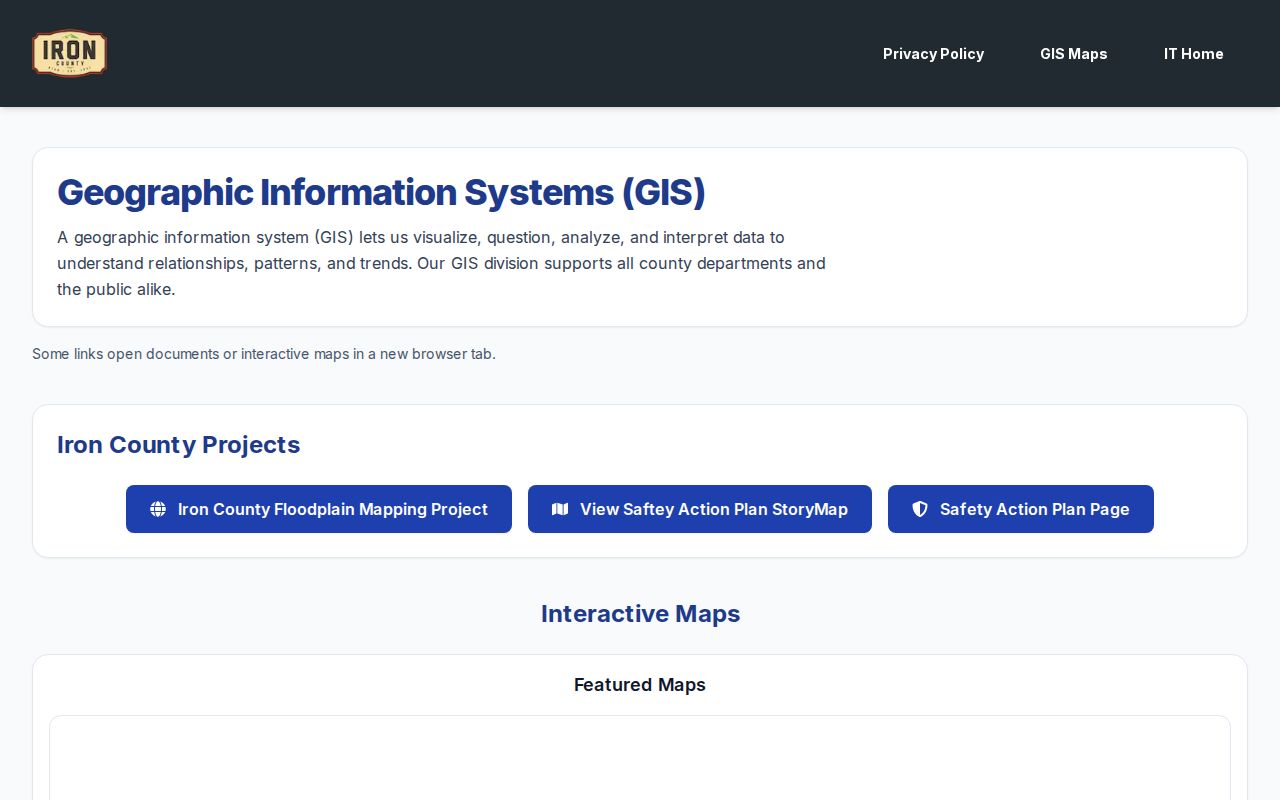
Use the map for boundaries, zoning, lots, and municipality context, then rely on recorded instruments for title questions. The official parcel service caps a response at 2,000 records, so a parcel, account, or tight place filter produces a more useful Cedar City result.
Cedar City Deed Chain Search
After finding a parcel account, open EagleWeb Document Search and carry over the parcel number or legal description. The index covers far more than deeds. It can return mortgages, liens, judgments, plats, surveys, boundary adjustments, annexation instruments, easements, leases, notices of default, powers of attorney, cemetery deeds, heirship decrees, patents, releases, and other recorded items. Iron County does not publish the exact electronic start year, so absence online is not proof that no older instrument exists.
Names appear in “Last Name First Name” order. Try the recorded spelling and likely variants. Date, parcel, document type, entry number, book and page, subdivision, lot, block, and public-land survey fields can narrow a common name. EagleWeb also supports a colon for ranges, a pipe for more than one value, and a trailing asterisk as a wildcard.
| EagleWeb field | Best use | Format note |
|---|---|---|
| Name | Find a grantor, grantee, or other recorded party | Last name first; Normal or Advanced mode |
| Parcel Number | Keep the search tied to one property | Copy punctuation exactly |
| Recording Date | Limit a long chain to a useful span | Start and end fields |
| Document Type | Separate deeds, liens, plats, and releases | Multi-select supports Ctrl or Shift |
| Legal and PLSS | Reach older or rural land descriptions | Subdivision or section, township, range |
The index is free, but recorded images are office-only. Note the entry number or book and page, then request the image at the Parowan Recorder counter. A recorded copy is listed at $1, while a seal and certification add separate charges. Phone first if the record is old or the visit falls on a Friday.
- Grantor
- The person or entity giving an interest in land.
- Grantee
- The person or entity receiving that interest.
- Legal description
- The land description that controls parcel identity, even when a street address changes.
- Entry number
- The Recorder's unique reference for a filed instrument.
Cedar City Court Name Lookup
Utah Xchange searches public district and justice court data by party name. For Cedar City, the Fifth District Court handles felony, civil, divorce, family, probate, and guardianship work. Iron County Justice Court handles lower-level misdemeanors, infractions, traffic matters, ordinances, and small claims. Search by last name or company, first name, case type, jurisdiction, statewide or local scope, date range, case number, birth date, or citation number. Names are stored as filed, so initials and spelling variants matter.
A result can show the court and county, case type and number, filed date, party names and roles, case history, and documents. Details may add the judge, lawyers, charges, agency, proceedings, orders, outcome, fine accounting, or an address given to the court. In probate, roles such as decedent, heir, guardian, and conservator can turn a case index into a family connection.
| Cedar City court source | Records covered | Practical access |
|---|---|---|
| Fifth District Court | Civil, felony, family, divorce, probate | Xchange, Cedar City clerk, courthouse terminal |
| Iron County Justice Court | Traffic, ordinances, small claims, B/C misdemeanors | Xchange or Cedar City counter |
| Utah State Archives | Historic Iron civil, criminal, probate, wills, registers | Digitized books plus reference request |
Remote Xchange is paid, while public terminals at most district courthouses can be free. Most district coverage is complete by the end of 1998, but justice conversion dates vary. Sealed and expunged matters, juvenile cases, adoptions, civil commitments, and protected parts of some family cases do not appear. Older Iron County alphabetical books at the Archives are a fallback, though digitized pages are not always full-text name searchable.
Cedar City Vital Records Routes
Recent Utah birth and death certificates are restricted records. The Southwest Utah Public Health Department at 260 E DL Sargent Drive gives Cedar City residents a local route for Utah birth certificates, while the Utah Office of Vital Records and Statistics accepts eligible orders online, by mail, and in person. State birth records begin in 1905. Birth certificates become public after 100 years and death certificates after 50 years under Utah Code §26B-8-125.
Marriage records split by custodian. Ask the Iron County Clerk for licenses issued by the county. The state vital office mainly supplies marriage and divorce abstracts for 1978 through 2010, with limited later coverage. A divorce abstract is not the same as a Fifth District case file or decree. Marriage, divorce, and other vital records generally become public after 75 years, subject to court restrictions.
Eligible certificate applicants must provide the required identification and relationship proof. Current base fees effective July 1, 2026 are $25 for a birth certificate, $35 for a death certificate, and $25 for a marriage or divorce abstract. Shipping, added copies, identity checks, and expedited services can add costs. The state reported an online and mail backlog of about six weeks in June 2026, so do not infer a delivery date from an expedite label.
Note: A state abstract, a court decree, and a county marriage license are distinct records, even when they describe the same event.
Cedar City Historic Newspaper Search
Utah Digital Newspapers provides a free Cedar City filter with 5,895 results captured in the research: 10 from Iron County News, 4,068 from Iron County Record, and 1,817 from Southern Utah University student newspapers. Search text can be paired with a year range and city, county, language, or newspaper facets. Each result identifies the paper, date, page, title, and item type.
Newspapers can link a name to an obituary, wedding, school activity, court notice, business, club, trip, or street address. Start with a surname, then try initials, a spouse formulation, an organization, and a narrow date span. Optical character recognition can miss a name on a worn, hyphenated, or stylized page. Inspect the page image and preserve the printed spelling before carrying the fact into another Cedar City record.
The Iron County Record ran from 1893 to 1982, and the student collection adds university names and events. Those runs are especially useful when a formal directory is missing or when a person stayed in Cedar City for a short school, railroad, tourism, or mining period.
Cedar City Cemetery Record Story
Cedar City cemetery evidence spans more than a marker. Burial cards run from 1858 to 1992, the interment register from 1860 to 1979, deeds from 1900 onward, lot files from 1904 to 1991, and an owner index from 1950 to 1988. City code requires the sexton to keep complete death, burial-location, and permit records open for inspection at reasonable times. Certified burial-right transcripts also go to the Iron County Recorder twice each year.
That overlap creates a strong family-history chain. One person may appear as the deceased on an interment card, while another appears as the purchaser or burial-right holder in a deed or lot file. Match the cemetery block, lot, dates, and names before treating them as the same role.
The Utah Archives cemetery map collection includes the official 1902 Cedar City map, which joins streets, blocks, property owners, survey detail, and a cemetery inset.
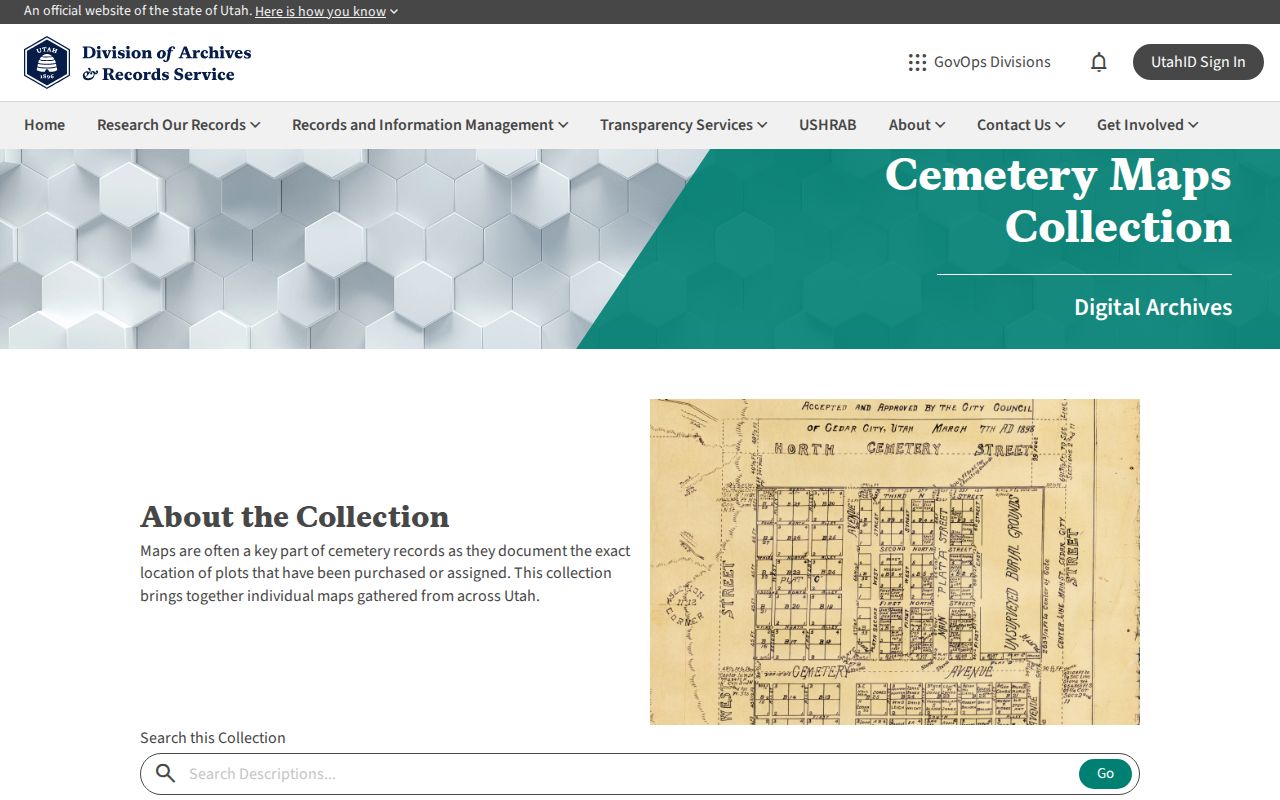
The map can bridge a town lot owner to a cemetery location, then deeds and newspapers can supply context. The Cedar City Cemetery office at 685 N Main handles present inspection questions; no current public interment-name search was verified.
Cedar City Search Before 1905
For births just before statewide registration, the Iron County birth register index supports name searches for 1898 through 1905. Preserve the index details and request the referenced record. For an earlier life, combine cemetery evidence, census schedules, newspapers, church or family material, probate, and land records. Exact Cedar City church-register runs were not verified, so a church source should be described only after its own coverage is confirmed.
The Cedar City Library at 303 N 100 E holds local personal and family histories, Iron County Memories oral histories, and histories tied to local industries, roads, music, and civic life. Some special-collection works cannot leave the room, and copyrighted items may be used onsite instead of copied. The library did not publish exact years for its printed city, reverse, or phone directories. Ask reference staff about the target year rather than assuming a run exists.
Southern Utah University's Digital Library adds course catalogs, programs, student papers, photos, books, film, and audio connected to Cedar City, Iron County, the university, and Paiute partners. These sources can follow a former classmate, faculty member, or civic participant when a current directory has long since changed.
Cedar City Corrections Name Lookup
No authoritative public Iron County jail roster was located. For a person believed to be in county pretrial custody, contact the Iron County Sheriff at 435-867-7500 or request a specific existing record through the proper channel. Do not substitute a state search and assume a blank result means the person is not in local custody.
The Utah Department of Corrections offender search accepts first and last name, with at least one letter in each, an optional middle name, or an offender number.
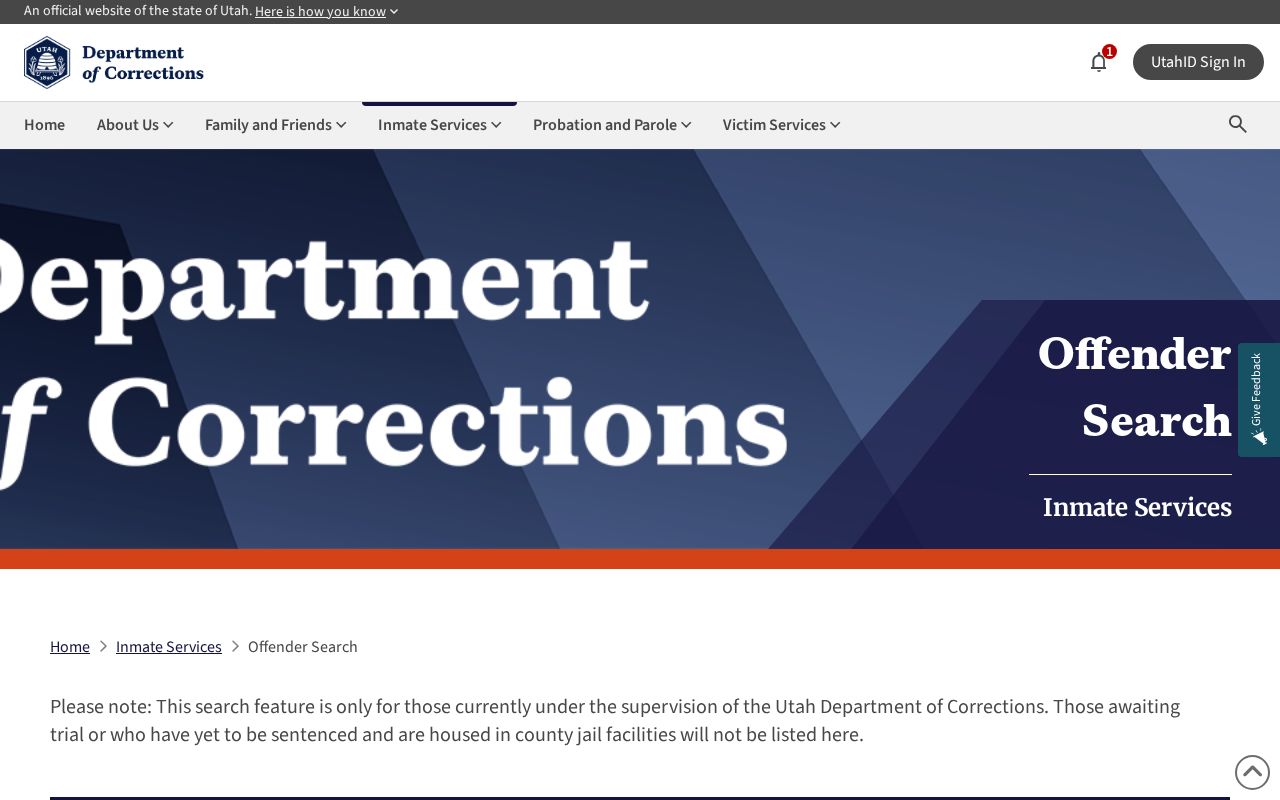
A state result can include the person's name and number, age or birth details, legal status, location, offenses, sentence history, Board hearing information, and commitment court or case. It covers Utah corrections supervision, not every arrest, jail booking, court case, or federal custody record. VINE provides custody notifications, and the federal Bureau of Prisons covers federal inmates. Those systems answer different questions.
Cedar City Business Contact Search
A business name can lead to several public contacts, but each source means something different. Utah's official entity search addresses registration. A UCC search can identify a debtor name exactly as filed. The Division of Professional Licensing verifies regulated credentials, and its Construction Business Registry can filter by professional type, classification, company text, license, city, state, or ZIP. That registry lists only active licensees who opted in, so it is not a full roster.
The Cedar City Chamber's public directory can show an organization, named contact and role, address, phone, and web contact. It also lists civic clubs and congregations through their public representatives, not through private membership rolls. A chamber entry is self-presented contact data. It does not prove that a license remains active or that the named representative owns the business.
Cedar City has no verified searchable public business-license register. For a specific existing city license record, contact the City Recorder or submit a narrow GRAMA request. Search registered names and spelling variants because a trade name may not match a formal entity or UCC filing.
Cedar City Voter Record Limits
Vote.Utah.gov lets a voter check their own status, polling place, and ballot status through an identity-verified route. It is not a public browse-by-name directory. Utah's 2026 law moved standard voter data into a controlled request process and replaced exact public birth dates with age bands. Full birth dates, driver-license or state-ID numbers, Social Security identifiers, email, phone, citizenship evidence, and at-risk information remain private.
The standard statewide file is a separate paid product with permitted-purpose, identity, security, agent, sharing, and use attestations. County or district subsets route to the Iron County Clerk, which did not post a local form or fee in the reviewed material. Vote history means the elections in which someone participated. It never reveals a secret ballot choice.
Voter access is covered end to end in Cedar City voter records. Safe at Home and the voter at-risk designation can limit address disclosure in their own systems, but neither should be treated as a tool for reconstructing a protected address from other files.
Cedar City Three Town-Site Search
Cedar City occupied three town sites. Settlers arrived in 1851, moved during the Walker War, and moved again in 1855 to the surveyed site outside the Coal Creek floodplain. Interstate 15 now cuts through part of the first fort site. An early lot described as Cedar City therefore cannot be forced onto today's street grid without checking which site and survey applied.
Early Iron County land books add another language shift. Deeds were called “transfers,” and bound books mixed transfers with surveys, patents, mining claims, and other instruments. Alphabetical public indexes were required early, while later systems separated grantor, grantee, class, and entry books. A modern Deed filter alone can miss an older Cedar City name.
Use the 1902 city and cemetery map, territorial surveys, legal descriptions, and period newspapers before assigning a modern address. The same date-aware rule helps with later growth. Annexation can change city services and zoning while the parcel remains under Iron County land-record custody.
Cedar City Search Cost Comparison
Official systems divide Cedar City access into free indexes, paid remote systems, and counter-only source records. A free name hit is often an index entry rather than the document itself. Commercial people-finder products compile information from many sources, but their results may be stale, merged, or stripped of the filing context needed to verify a person.
| Search route | Cost pattern | What to verify |
|---|---|---|
| EagleWeb account and document index | Free online | Owner, parcel, entry, book and page |
| Recorded deed image | Office-only; listed copy fee | Instrument text, parties, legal description |
| Utah Xchange | Paid remote; courthouse terminal may be free | Court, party role, filing date, disposition |
| Archives and newspapers | Free digital or onsite/request copy | Series coverage, page image, spelling |
| Compiled commercial result | Varies | Every fact against the official custodian |
Choose the route that preserves the source. An index helps discovery, while the deed, order, certificate, register page, or newspaper image supplies the record's context. Save the record date because Cedar City parcels, addresses, courts, and directory entries change.
Cedar City records are for lawful personal and civic research. Public access is never permission to stalk, harass, threaten, or expose a protected address.
Cedar City Record Request Fallback
When a Cedar City file is not online, identify the office that created or keeps it. Ask for an existing record, not an answer assembled from several files. Include your name and contact details, the subject's name variants, a tight date range, the record type, office or division, and any known address, parcel, case, permit, license, entry, book, or page number. State whether electronic delivery or inspection will work and request a fee estimate when cost matters.
Utah's Government Records Access and Management Act allows any person to request a government record. A normal response is due within 10 business days, or five when the requester shows a qualifying public benefit. An agency may provide the record, deny it with legal authority, identify a likely custodian, or invoke an extraordinary circumstance and schedule. Silence counts as a denial. Actual-cost fees may apply, but an office generally does not charge merely to classify a record or for ordinary inspection.
Use the Cedar City GRAMA request form for municipal files. Recorder copies usually move through the ordinary Recorder service. Court records follow Judicial Council rules. For state requests, the Open Records Portal can route and retain request metadata, but delivered files remain available for only 60 days, so download them promptly.
A denial can be appealed first to the chief administrative officer, normally within 30 days, and then through the Government Records Office or district court. Utah's records ombudsman can consult or mediate. Often the fastest fix is a documented, narrower request that names the exact Cedar City record series and date.