
Cedar City Public Records Scope
Utah law starts with the record, not the building where someone asks for it. Cedar City keeps Council minutes, ordinances, contracts, cemetery files, business-license material, permits, and other municipal files. Iron County keeps land, assessment, tax, marriage, and election material. Utah agencies control statewide court, vital, corrections, license, business, and archival systems. The table identifies the normal keeper and the key online or counter route.
| Record group | Keeper | Digital route | Practical access |
|---|---|---|---|
| Deeds, liens, plats | Iron County Recorder/Surveyor | EagleWeb index | Free index; images and copies at Recorder counter |
| Parcel and tax accounts | Assessor, Recorder, Treasurer/Auditor | EagleWeb and county GIS | Free account and map searches; office or GRAMA fallback |
| District and justice cases | Utah Judiciary and local court clerks | Utah Xchange | Paid remote search; free courthouse terminals may be available |
| City administration and permits | Cedar City departments | City pages and construction registry | Published files, office inspection, or city GRAMA request |
| Birth, death, marriage, divorce | Utah OVRS, health district, clerk, or court | Order service and historic indexes | Recent copies restricted; older records open by statutory age |
| Corrections and police | Utah DOC, Iron County Sheriff, Cedar City Police | DOC search; police request form | State lookup or a specific agency request |
The Government Records Access and Management Act, called GRAMA, allows any person to seek an existing government record without a Utah residency rule. It does not make every field open. Recent vital certificates, sealed or expunged matters, juvenile and adoption files, protected court filings, motor-vehicle data, and identifying details tied to protected voters or Safe at Home participants can be closed or limited.
Office boundaries matter here. Cedar City is Iron County's largest city, but Parowan is the county seat. A request for a city ordinance belongs at City Hall. A deed image belongs with the Recorder in Parowan. A Cedar City district case goes to the Fifth District clerk or the statewide court system, not the Iron County Clerk.
Note: The county Clerk manages marriages and elections, while Cedar City court files belong to the state Judiciary and local court clerks.
Cedar City Recorder Record Index
Iron County EagleWeb searches recorded-document metadata at no charge. Its exact electronic start year is not published, so an empty result does not establish that no older instrument exists. Names are entered last name first name. Advanced syntax supports colon ranges, a pipe for multiple values, and an asterisk suffix wildcard. Document types span deeds, mortgages, liens, judgments, plats, easements, leases, mining instruments, cemetery filings, decrees, and releases.
| Search field | Input or option | Use |
|---|---|---|
| Name | Normal or Advanced | Find grantors, grantees, and other indexed parties |
| Entry or book/page | Number or range syntax | Retrieve a known index reference |
| Parcel number | Exact or supported search syntax | Group filings tied to one parcel |
| Recording date | Start and end | Limit results to a useful period |
| Legal geography | Subdivision, lot, block, tract, unit, section, township, range | Find land when a modern street address fails |
| Document type | Multi-select or all types | Separate deeds, liens, plats, and other filings |
The live EagleWeb entry screen shows how document and property searches share one county portal.
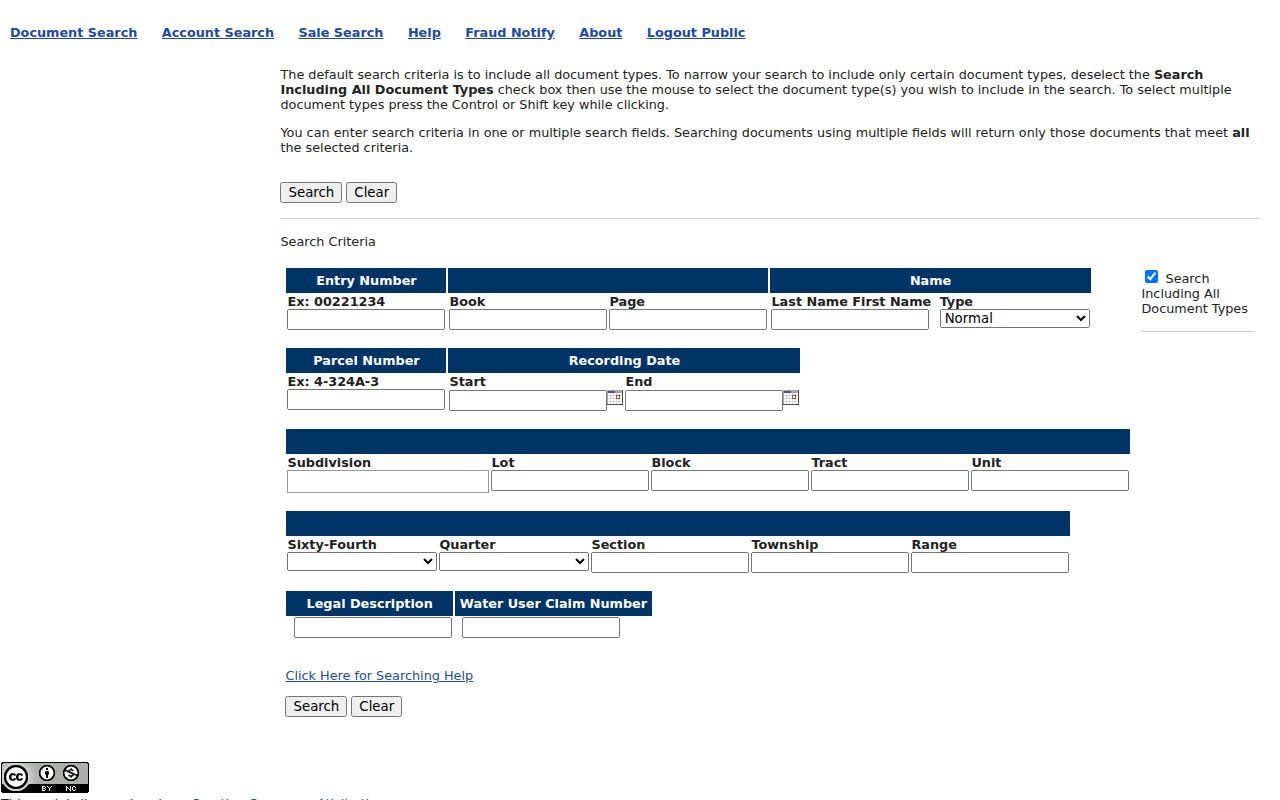
The screen is a finding aid. Preserve the entry number or book and page, then use it to ask the Recorder for the actual recorded image.
Cedar City Public Records Copies
EagleWeb's free index and the underlying instrument are not the same product. Recorded images remain office-only. Call the Iron County Recorder at 435-477-8350 before traveling to Parowan, especially on Friday, when published county hours end at noon. A record already identified by entry number or book and page can usually move through ordinary copy service. A narrow written request is the fallback when an unpublished existing record is needed.
The county schedule effective May 6, 2026 lists a recorded copy at $1, a xerox copy at $0.10, and a seal at $5. It also lists $45 for recording a standard document and $55 per subdivision-type plat page. Those last charges concern filing a new instrument, not merely searching the index or buying a copy.
- Index
- A list of filing facts that points to a document but does not replace its contents.
- Recorded image
- The filed instrument itself, viewed or copied through the office.
- Certified copy
- A copy authenticated by the custodian for uses that require official proof.
- Custodian
- The agency or office responsible for keeping and answering for the record.
- Exemption
- A legal basis for withholding a record or part of one.
Note: Ask for the least costly usable form, since an index result, plain copy, sealed copy, and certified copy serve different needs.
Cedar City Property Record Portals
The Iron County Assessor manages about 43,000 parcels, making the property roll one of the broadest named local record sets. EagleWeb Account Search accepts an owner, account or parcel number, a structured situs address, tax district, value or acreage range, property type, subdivision fields, and public-land survey fields. A situs address is the physical parcel location. A mailing address is where tax correspondence goes. Neither proves who currently occupies the land.
The Iron County Assessor links property account access and explains the office's role in value and classification.
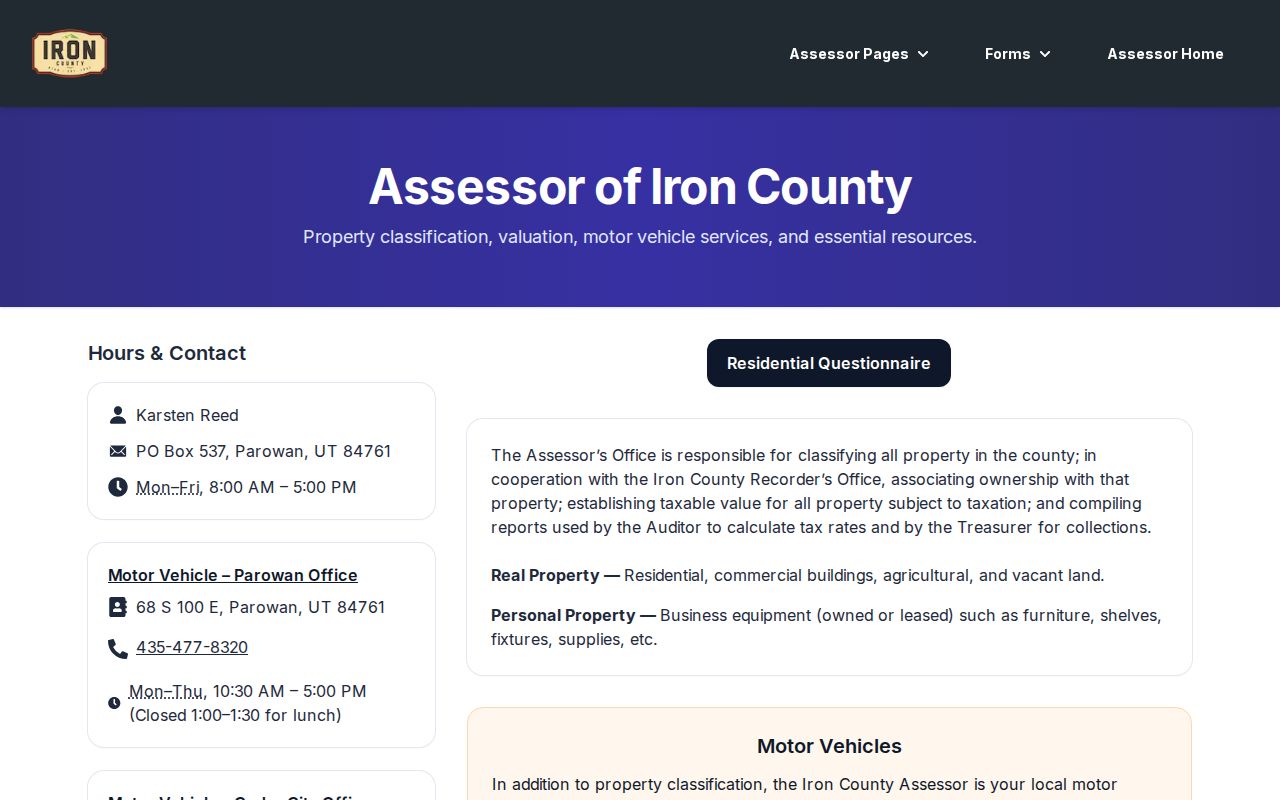
The account record can show owner, mailing and situs addresses, parcel and account identifiers, legal description, value, taxes, acreage, subdivision or survey location, district, and class. The county's GIS resources add mapped boundaries, municipality, zoning, lot, and district context, but the map is not a title decision.
A Cedar City mailing label does not settle whether land sits inside municipal limits. Compare the portal's municipality and tax district with GIS geometry. Annexation can change city services or zoning while the land record remains in Iron County custody. The official street-numbering plat is held by both the city and county Recorders, a useful safeguard when a grid address or older lot description is unclear.
Cedar City Court Records Access
Utah Xchange covers public district and justice case information. The Fifth District Court at Cedar City handles felony, class A misdemeanor, civil, divorce and family, probate, and guardianship matters. Iron County Justice Court handles lower misdemeanors, infractions, traffic, ordinances, and small claims. Juvenile cases are not on Xchange, and the county Clerk expressly is not the clerk of courts.
Utah's official Xchange help illustrates searches by jurisdiction, case number, party or company name, case type, court scope, date, citation, and birth date when permitted.
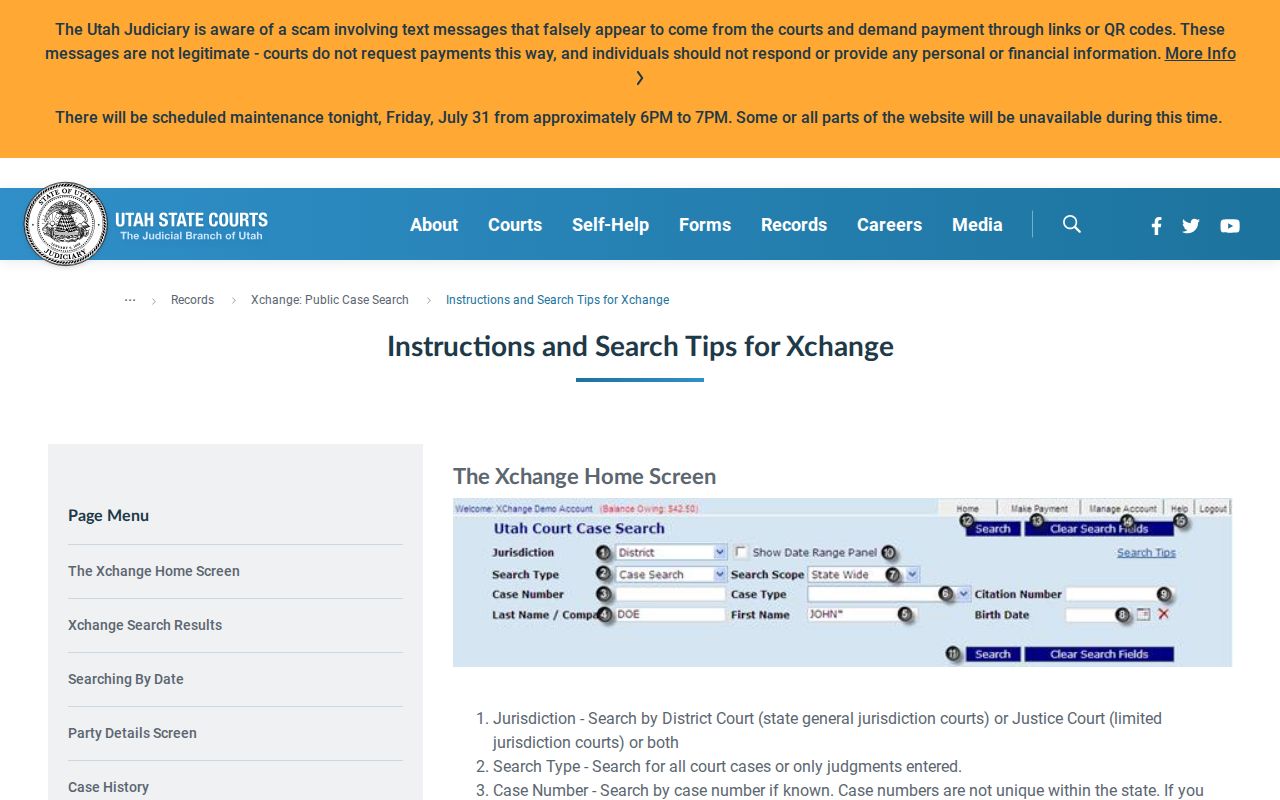
Results may identify the court, case type and number, filed date, parties and roles, then open a history or document view with judges, lawyers, charges, minutes, orders, outcomes, and accounting. Names appear as filed, so variants matter. Most district coverage is complete by the end of 1998, while justice conversion dates vary. Public electronic district filings date from July 1, 2010.
Remote use is paid. The current court fee page lists a $10 initial credit, searches at $0.35 each, and documents at $1. A guest session forfeits unused credit, while a one-time account can retain it. A subscription costs $25 to set up and $40 monthly for 500 searches. Free terminals are available at most district courthouses and at the State Law Library. For an older Cedar City matter, the digitized Iron County Fifth District indexes can supply a case number, but many books must be browsed rather than full-text searched.
Cedar City Vital Records Access
Utah Code §26B-8-125 opens birth records after 100 years, death records after 50 years, and marriage, divorce, and other vital records after 75 years. Newer certified copies require a qualified requester and proof that fits the record type. Utah's Office of Vital Records and Statistics covers births and deaths from 1905 forward and offers limited marriage and divorce abstracts, mainly for 1978 through 2010.
The Southwest Utah Public Health Department at 260 E DL Sargent Drive provides a Cedar City route for Utah birth certificates. State orders may be made online, by mail, or in person. Mail requires the signed form, an ID copy, correct payment, and any needed proof of relationship. An eligible in-person order may be issued the same day, while the state reported about a six-week online and mail backlog in June 2026.
Fees effective July 1, 2026 are $25 for a birth certificate or marriage/divorce abstract and $35 for a death certificate. Added copies of the same record in one order are $10. Shipping, identity checks, online convenience, and optional expedited services can add separate charges. A failed search does not return the base search fee.
For a pre-statewide birth, the Iron County 1898 to 1905 birth index offers a free name search. Older public certificates route to the Utah State Archives. Marriage licenses issued in Iron County are best directed to the county Clerk, while a full divorce file belongs with the Fifth District Court rather than the vital-statistics abstract service.
Private Records in Cedar City
Public status can apply to part of a record without opening every field. A deed can disclose parties and title facts while protected identifiers are redacted. A court docket or order may remain visible when a family-case filing is private. Standard voter fields may be delivered only through the election-law channel, while full birth date, identification numbers, phone, email, citizenship evidence, and at-risk voter information remain private.
Safe at Home supplies a substitute address and mail-forwarding route for qualifying survivors who enroll through the official program. Voter at-risk status limits disclosure from the voter system. Neither program erases old documents that were lawfully created. A responsible search does not combine fragments to reconstruct a concealed address or expose someone whom Utah law protects.
Lawful personal use. Access to Cedar City records is not permission to follow, monitor, threaten, or harass a person. Utah stalking law covers repeated conduct involving surveillance, contact, or obtaining and spreading information when its legal elements are met.
Note: Safe at Home and at-risk voter status restrict different systems; neither authorizes rebuilding a protected address from other data.
Cedar City Custody Record Channels
Custody information is divided by jurisdiction and status. The Utah Department of Corrections search requires a first and last name with at least one letter in each, or an offender number; a middle name is optional. A result can describe a person under current state supervision, legal status, location, offenses, sentence history, and Board dates. It does not serve as an Iron County pretrial jail roster.
VINE accepts a name or offender number and provides custody notifications by web or at 877-884-8463. Federal custody belongs in the federal inmate locator. The Utah Attorney General registry gateway is the official route for registry data, but its current interface fields were not verified and should not be assumed. No authoritative public Iron County jail roster was located.
For county detention, call the Iron County Sheriff at 435-867-7500 or make a precise records request. For a Cedar City police report, use the police form, email, fax, or front desk channel. A jail booking, police report, court docket, conviction, and DOC supervision entry are separate records. Match identity and dates before treating two entries as the same person.
Note: VINE alerts are a notification aid, not a substitute for confirming current custody with the responsible agency.
Cedar City Public Records Offices
Choose an office by legal custody, not convenience. City Hall answers for municipal material. The Recorder and county Clerk are in Parowan. Court and assessment counters also serve Cedar City. Calling first can confirm hours, whether an index reference is enough, and whether the office accepts an electronic request.
Police records use a dedicated form rather than the general city route. Cedar City Police accepts submissions online, by fax, by email at police@cedarcity.org, or at the front desk. Published charges include $5 for a police or accident report, $0.25 for each added report page, and separate photo or disc charges. Release waits for proof of payment.
Cedar City Historic Records Gaps
Modern portals do not mark the start of local recordkeeping. Early Utah recorder books called deeds “transfers” and mixed surveys, patents, mining claims, and land conveyances. A search limited to a modern deed type can miss that older language. Iron County's exact EagleWeb cutover is not published, so ask the Recorder about bound books, older indexes, and office access when an expected name or legal description is absent.
The Utah State Archives holds digitized Iron County civil, criminal, and probate indexes and registers. Criminal registers survive from 1896 through 1990. A 2008 preservation project processed Fifth District records from 1896 through 1955, and a 2018 digitization project replaced a paper and microfilm index workflow. Images can be light, out of focus, or arranged for browsing rather than name search.
Cemetery records create another long chain. Cedar City interment registers begin in 1860, deeds in 1900, lot files in 1904, and a lot-owner index in 1950. The city sexton keeps burial and location records open for inspection at reasonable times, while plats and twice-yearly certified burial-right transcripts also reach the County Recorder. Newspapers, SUU collections, and Archives references can add context, but they do not substitute for an official certificate or court file.
Note: Preserve the spelling, case number, entry number, legal description, and source date before leaving a browsed image or office index.
Cedar City Public Records Fees
GRAMA permits reasonable fees based on actual cost. An agency may not charge merely to classify a record or, in the ordinary case, for the first quarter-hour of staff time. Prepayment may be required when estimated charges exceed $50 or when the requester has an unpaid balance. A waiver may apply for a demonstrated public benefit, for access to one's own record, or on another statutory ground.
Portal prices follow separate systems. EagleWeb index searching is free, while the Recorder charges for copies and certification. Xchange remote searching and documents are paid, while courthouse terminal use can avoid remote search charges. Vital-record fees changed on July 1, 2026 and can include several distinct add-ons. Ask for an estimate, state a maximum amount, and say whether inspection or an electronic copy will meet the need.
The statewide Open Records Portal stores request and response metadata for five years, but delivered files remain downloadable for only 60 days. Save the delivery promptly. Retention rules also matter: GRAMA grants access to records that exist, but it does not require an agency to create an answer, compile a biography, or retain a series beyond its approved schedule.
Requesting Cedar City Public Records
A useful records request identifies an existing record and the correct custodian. Cedar City's official GRAMA form asks for the requester's name, address, phone, email, date, signature, and a specific description. It also provides status choices for a public requester, the record subject, a parent or guardian, a provider, an authorized representative, or a person acting under legal process. Send only the proof needed for the asserted status.
- Identify the keeper. Separate city, county, court, and state custody before submitting anything.
- Check the published route. Search the relevant index or catalog and record any parcel, case, permit, entry, or book-page number.
- Describe the existing file. Give names and variants, record type, office, address, date range, and known identifiers. Request an electronic copy or inspection if either works.
- Set cost terms. Ask for an advance estimate, state a maximum fee, and give any valid waiver basis.
- Preserve the response. Keep the request, timestamp, fee messages, records received, and any cited reason for withholding.
Under Utah Code §63G-2-204, the normal response limit is ten business days. Five business days applies only when a qualifying public-benefit expedition is shown. The agency must provide the record, issue a supported denial, identify a likely custodian when known, or invoke extraordinary circumstances and give a schedule. Silence counts as a denial.
Appealing Cedar City Records Denials
A denial should identify what was withheld, the legal basis, and the route to appeal. First preserve the exact wording of the request and response. A narrower request can resolve a dispute over breadth faster, but document the change so the scope remains clear. If the agency says it lacks the record, follow any named likely custodian because the Cedar City, Iron County, court, and state split often explains the mismatch.
A GRAMA appeal generally starts with the agency's chief administrative officer within 30 days. Further review can proceed to the Government Records Office Director or district court. The Utah State Archives records ombudsman also offers consultation and mediation. Court records follow Judicial Council access rules, so do not assume that a judicial denial uses the same municipal or county GRAMA path.
Good requests remain narrow and factual. Ask for existing permit-register entries for an address and date range, not an answer to who lived there. Ask for a deed by entry number, a police report by case number, or a court file by docket reference. That level of detail helps the custodian search, price, classify, and release the right material without guessing at the requester's aim.